Prep by Company
Software Dev Engineer SDE Product Manager PM Data Scientist DS Data Engineer DE ML Engineer MLE Technical PM TPM
Software Engineer SWE Product Manager PM Data Scientist DS Data Engineer DE ML Engineer MLE Technical PM TPM
Software Engineer SWE Product Manager PM Data Scientist DS Solutions Architect SA ML Engineer MLE Technical PM TPM
Guides About Get Your Playbook →
Built by an ex-Amazon Bar Raiser · 8 years · 100s of interviews conducted

Stop guessing
what they're
looking for.

Most candidates prep for questions. The ones who get offers prep for how they’re evaluated. Your playbook does both — built from your resume, your job posting, and how this company actually decides who to hire.
30-day money-back guarantee
Delivered within 24 hours
Every playbook reviewed before delivery
Ex-Amazon Bar Raiser
8 years · 100s of interviews conducted
2,699+ interviews analyzed
To surface the patterns that actually matter
7 Tier 1 companies
Amazon, Google, Meta, Microsoft, Apple, Netflix, NVIDIA
6 most in-demand roles
SWE, PM, DS, DE, MLE, TPM

You bring your resume.
We bring the rest.

Your resume and the job posting tell us where you're starting from. What happens next — matching your background against years of data on how this company actually hires — is on us.

Step 01
Upload your resume and the job posting
Paste in the exact job description you're applying for and upload your resume. That's all we need from you. No questionnaires, no intake forms — we do the heavy lifting from here.
Step 02
We run your profile against everything we know
Your background gets matched against what we know about how this company evaluates candidates for this role — the question patterns, the rubrics, what strong looks like at each level, and where candidates like you typically win or lose. Then a human reviews the result before it goes out.
Step 03
Your playbook arrives within 24 hours
A 50+ page PDF in your inbox — specific to you, grounded in how this company actually decides who to hire, and ready to use from the moment you open it.
"Most prep teaches you how to answer.
We teach you how they evaluate."

Interview101 was built by an ex-Amazon Bar Raiser — someone who sat on the other side of the table for 8 years and conducted hundreds of interviews across SWE, PM, DS, and TPM roles. The Bar Raiser role exists specifically to hold the hiring bar. We know what separates a hire from a no-hire because we made that call, hundreds of times.

What we found is that candidates who fail don't usually fail because they're unqualified. They fail because they don't know what the interviewer is actually looking for, they haven't connected their own experience to the company's values, and they walk in hoping their stories land rather than knowing they will.

That's the gap Interview101 was built to close.

8
years conducting
interviews at Amazon
100s
of Hire / No Hire
decisions made
2,699+
candidate interviews
analyzed to build this
The evaluator's rubric is real
The evaluation criteria in your playbook reflects how interviewers are actually trained to assess candidates — not forum speculation.
Every rubric is real
The evaluation criteria in your playbook isn't sourced from forums or guesswork. It reflects how interviewers are trained to assess candidates.
A plan ready to execute
Not a course. Not a session. A complete, structured playbook you can start working through the moment it arrives — organized by what to do first.
Data updated quarterly
Interview patterns change. We only use reports from the past 3 months. What worked 18 months ago may not work today.

The three things that decide your interview.

Most prep focuses on knowledge. What actually decides the outcome is how well your stories land, whether you know the questions coming, and whether you understand what the interviewer is evaluating for. Your playbook covers all three.

Your stories,
already written.
Most candidates know they have good experiences. They just don't know how to find the right ones, frame them as STAR stories, or know which stories Amazon wants vs. which ones Google wants. Your playbook does that work. Full STAR stories pulled directly from your resume bullets, each one mapped to the values and leadership principles this company weighs most heavily in behavioral rounds.

Walk in with a ready answer for every question type they're likely to ask — not a framework you need to apply under pressure, but an actual story, already structured.
No other tool builds your stories from your actual resume
The questions that
prepare you best.
Not a list of "common interview questions." The questions that will prepare you best — ranked by how frequently they appear for this company and role, each matched to which of your stories maps best to it.

There's a big difference between "being ready for behavioral questions" and knowing which specific question types this company weights most heavily, which of your stories maps to each one, and why. Your playbook makes that connection explicit — for the exact company and role you're interviewing for.
2,699+ reported interviews — updated quarterly
What strong looks like
from their side.
This is the thing candidates can't get anywhere else. Not "how to answer behavioral questions" — but the actual rubric interviewers use to decide Hire vs. No Hire. What does a strong answer look like at the level they're hiring for? What signals trip the evaluator? Where do candidates who look good on paper consistently lose the offer?

Your playbook includes the evaluation criteria — your fit score against it, your top gaps ranked by risk, and a script for each gap that acknowledges it, pivots, and closes with evidence.
Built by someone who made the Hire/No Hire decision
Inside Your Playbook

What it actually looks like.

Six sections from a real playbook — built for a Senior SDE applying to Amazon. Yours is built the same way, from your resume.

2
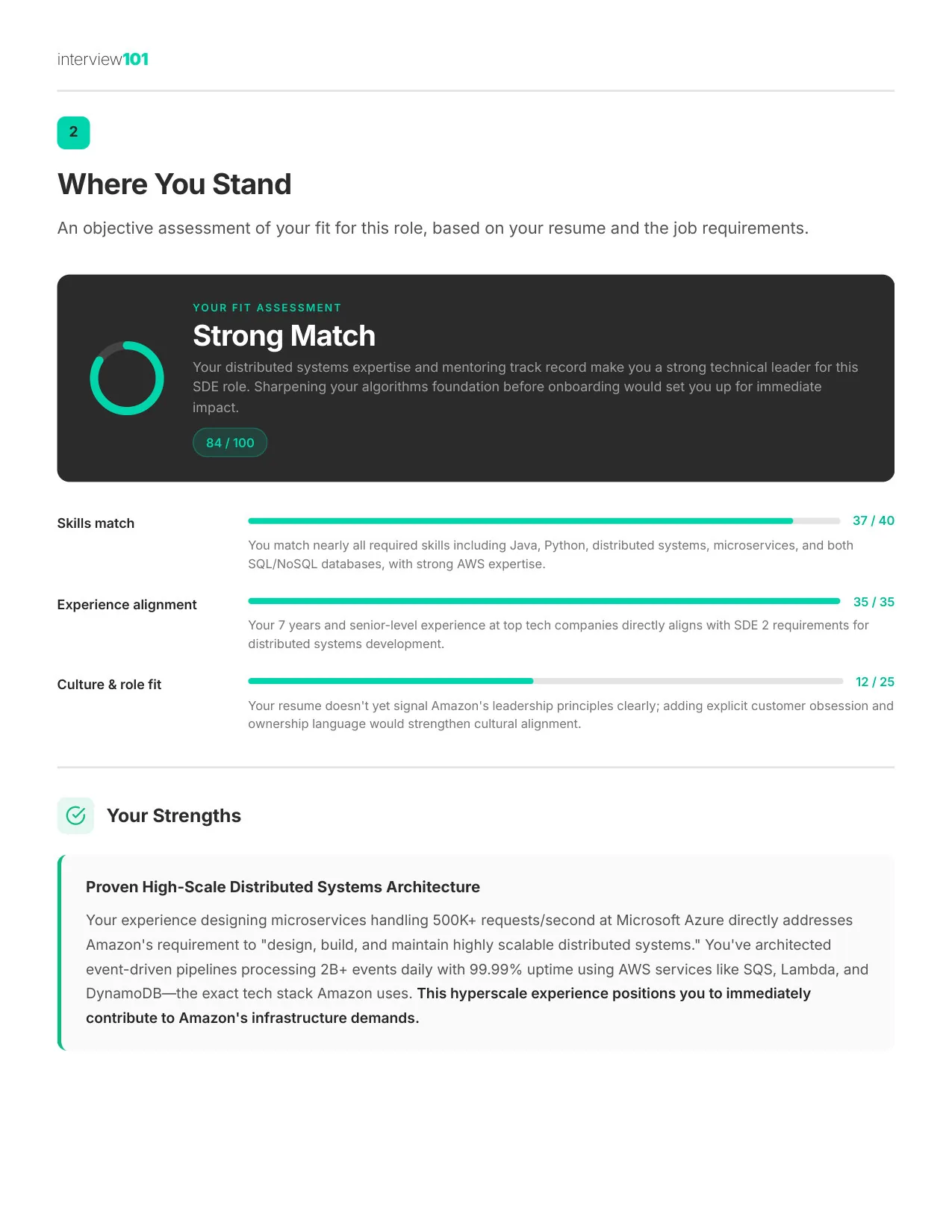
Section 2 — Where You Stand
Your fit score — with evidence behind every number.
84
/100
Your Fit Assessment
Strong Match
Distributed systems depth strong.
Culture signals need reinforcing.
Skills match
37 / 40
Experience alignment
35 / 35
Culture & role fit
12 / 25
Skills and experience are where most candidates feel ready. Culture fit is where they get surprised. Your playbook shows you exactly why — and what to do about it.
3
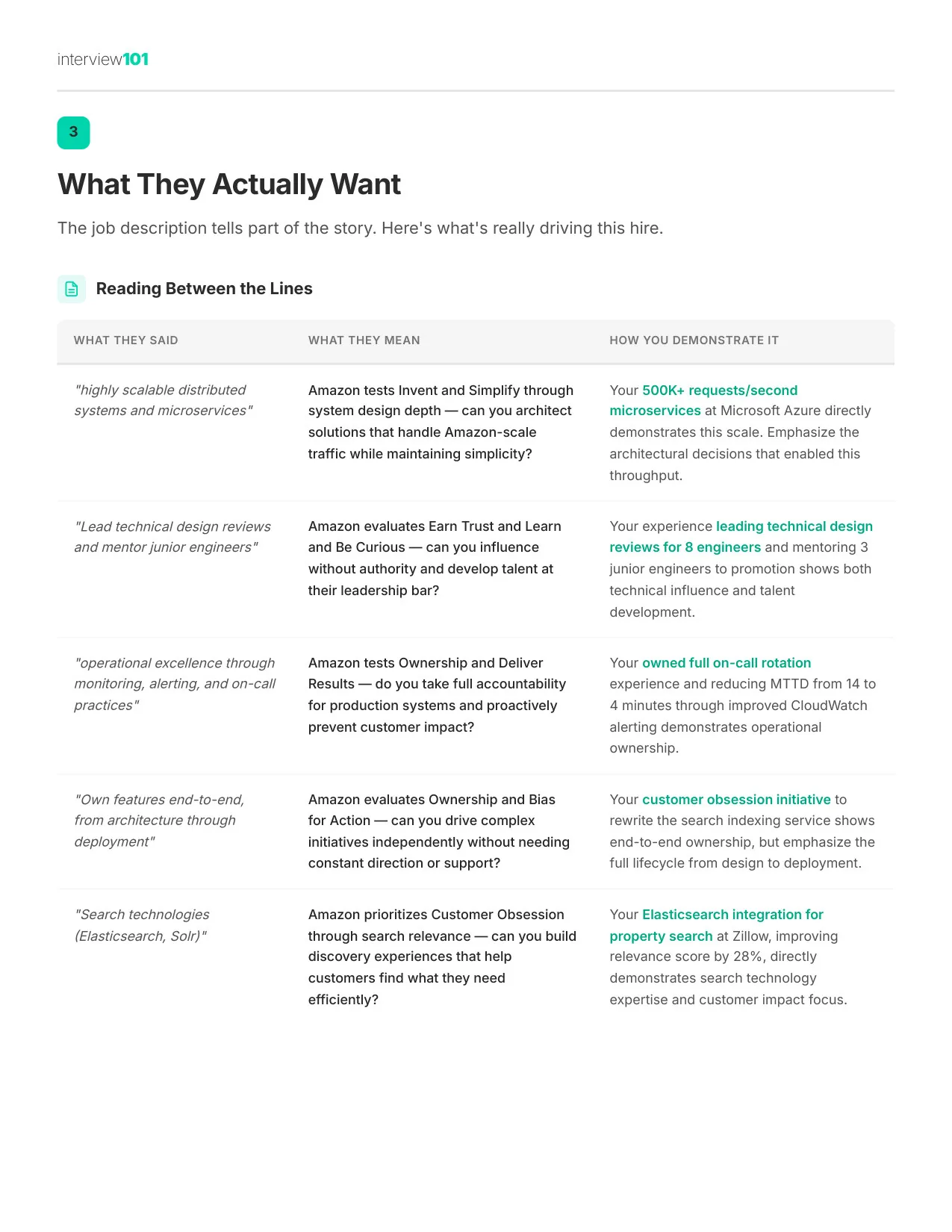
Section 3 — What They Actually Want
The job description decoded into evaluator language.
What they saidWhat they meanHow you demonstrate it
"highly scalable distributed systems"Tests Invent & Simplify — architect at Amazon-scale while keeping it simple?Your 500K+ RPS microservices at Azure directly demonstrates this scale.
"Lead design reviews and mentor"Evaluates Earn Trust — influence without authority and develop talent?8-engineer design reviews + 3 engineers mentored to promotion.
"operational excellence through on-call"Tests Ownership — full accountability for production systems?Full on-call rotation + MTTD reduced from 14 to 4 minutes.
The job description tells part of the story. This section decodes what each requirement actually means to the interviewer — and maps it line by line to your background.
5
Section 5 — Stories That Win Interviews
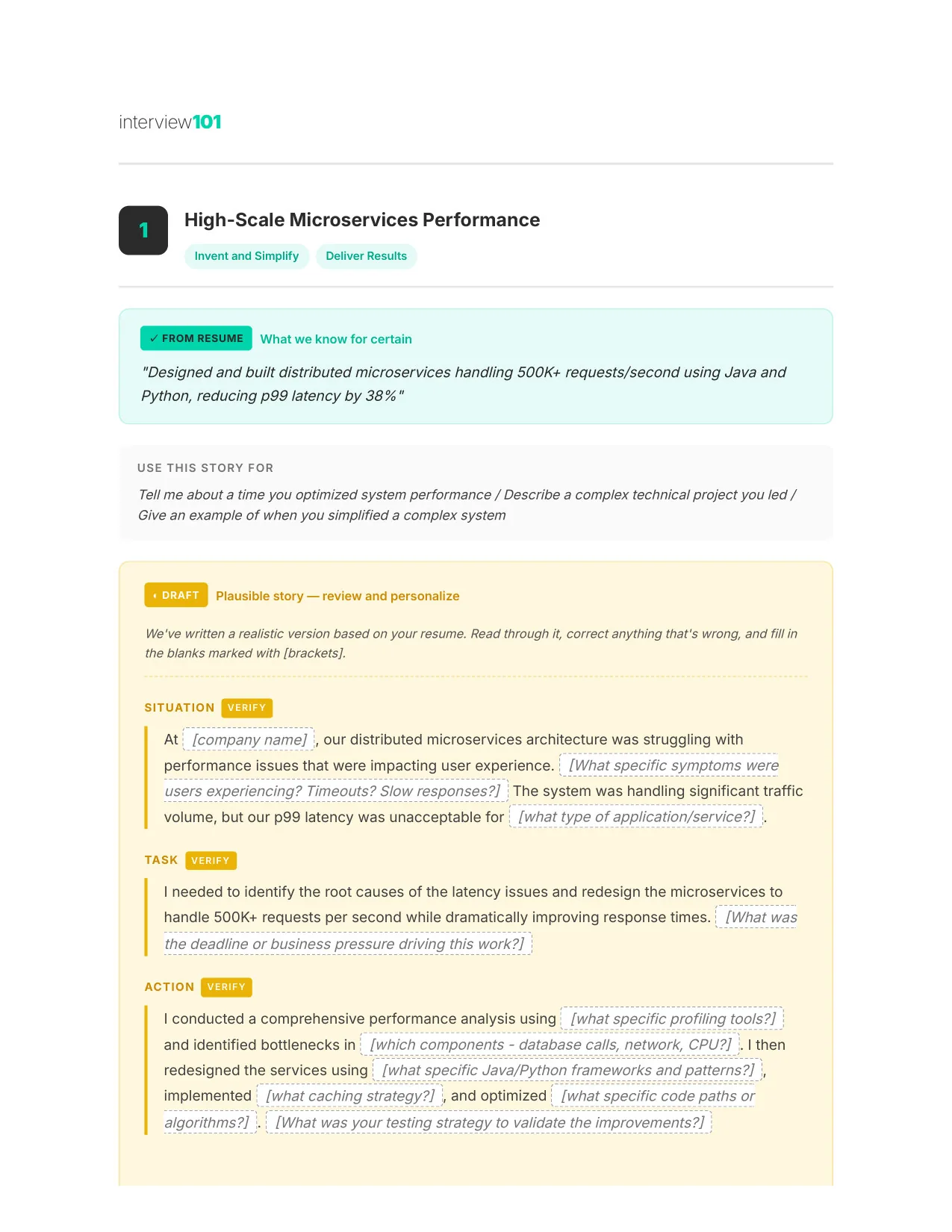
STAR stories drafted from your resume — not templates to fill in.
✓ From Resume
"Designed microservices handling 500K+ req/sec, reducing p99 latency by 38%"
Situation Verified
At [company], our microservices were struggling with performance issues. p99 latency was unacceptable for [service type].
Action Verify this
I conducted a performance analysis using [profiling tools] and redesigned using [frameworks + patterns].
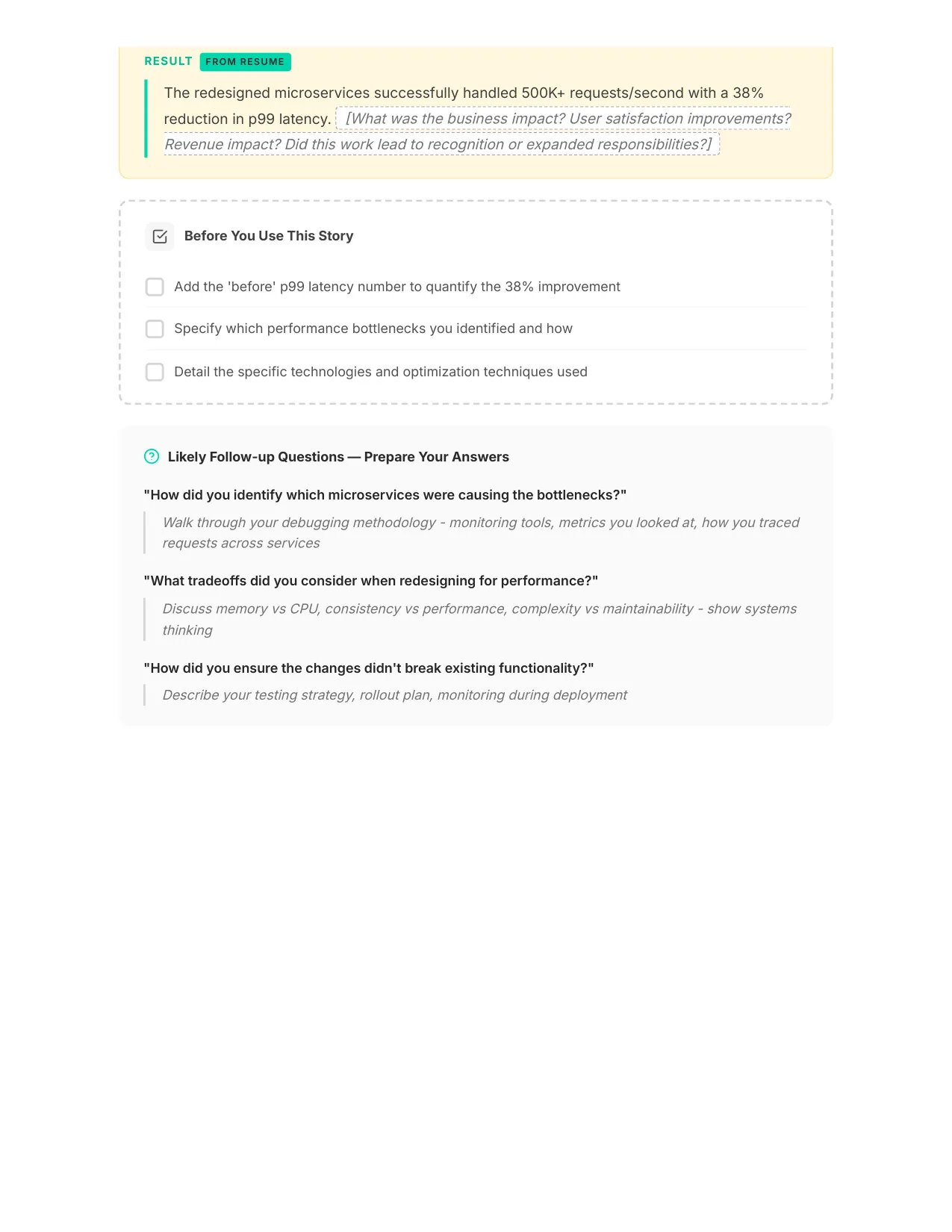
Result From Resume
Successfully handled 500K+ req/sec with a 38% reduction in p99 latency.
Green = verified from your resume. Amber = plausible draft to confirm. White = only you know this. 8 stories built this way — grounded in what you actually did.
6
Section 6 — Questions You'll Face
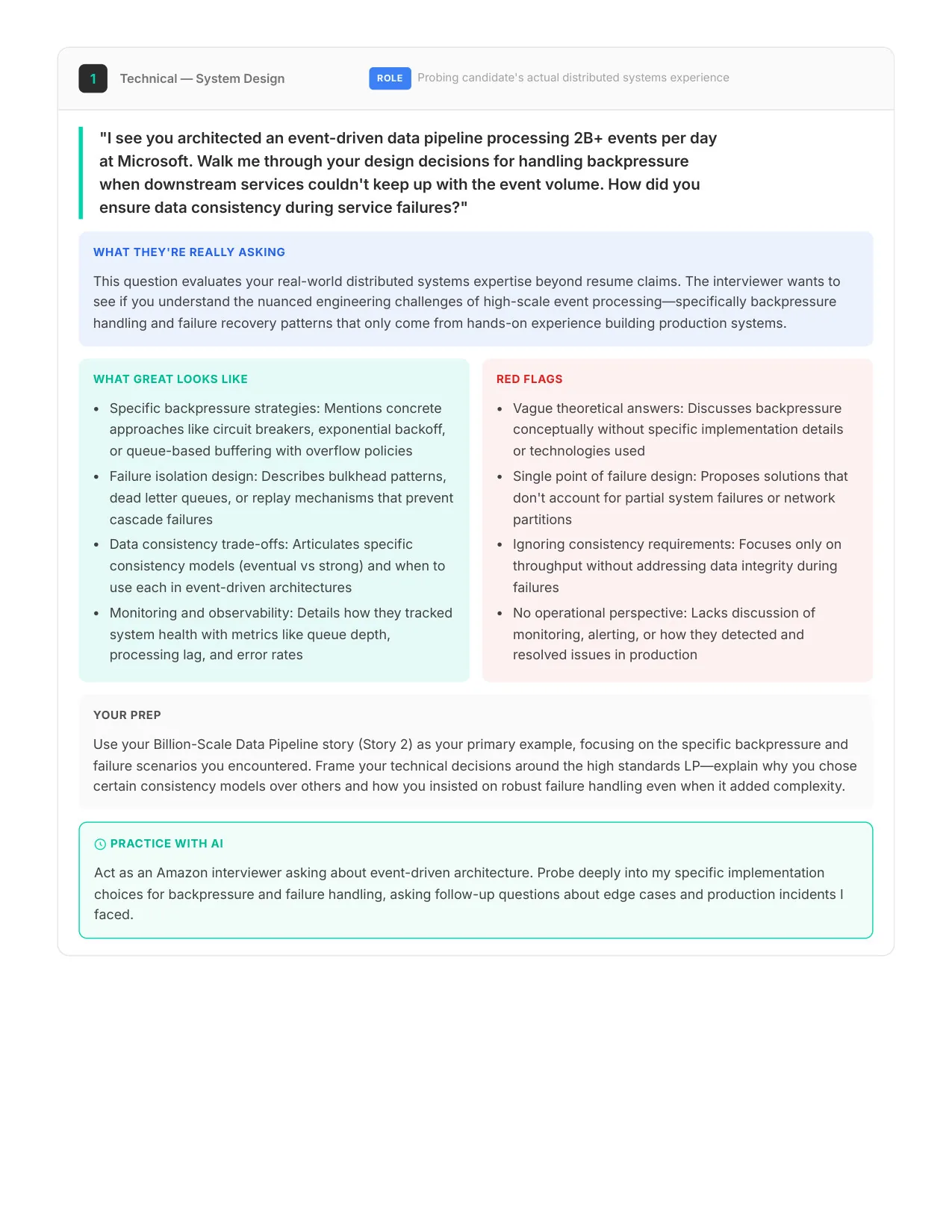
12 questions built for your specific interview — with what great looks like.
System DesignYour Resume
"Walk me through your design decisions for handling backpressure when downstream services couldn't keep up with your 2B+ events/day pipeline."
What great looks like
Names specific strategies: circuit breakers, exponential backoff, queue buffering
Articulates consistency models — eventual vs strong
Discusses monitoring: queue depth, processing lag
Red flags
Discusses backpressure theoretically — no specific implementations
No monitoring or alerting discussion
Single point of failure design
Each question includes what the interviewer is really evaluating, what a strong answer demonstrates, and the exact patterns that cause qualified candidates to fail.
7
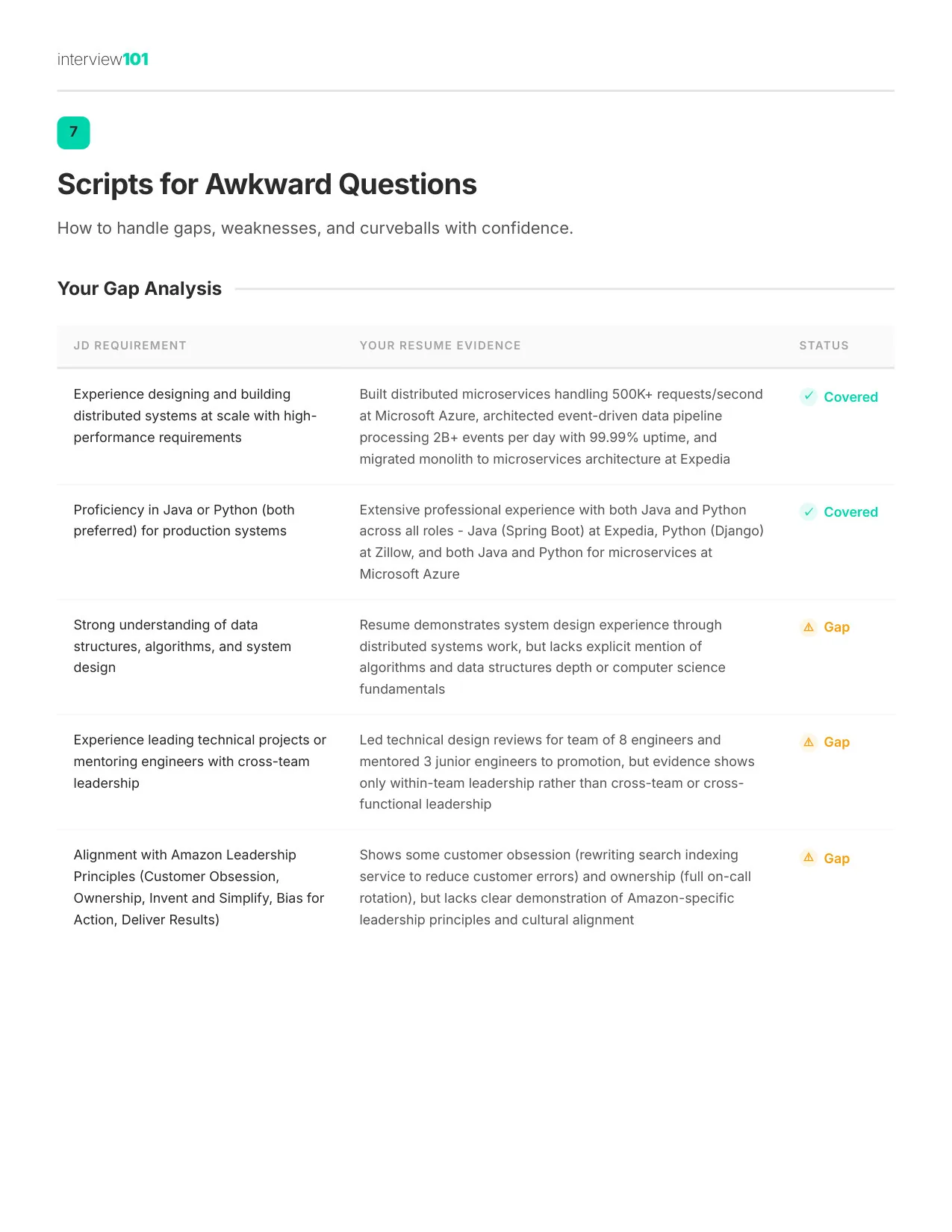
Section 7 — Scripts for Awkward Questions
The exact words to say when they find your weakness.
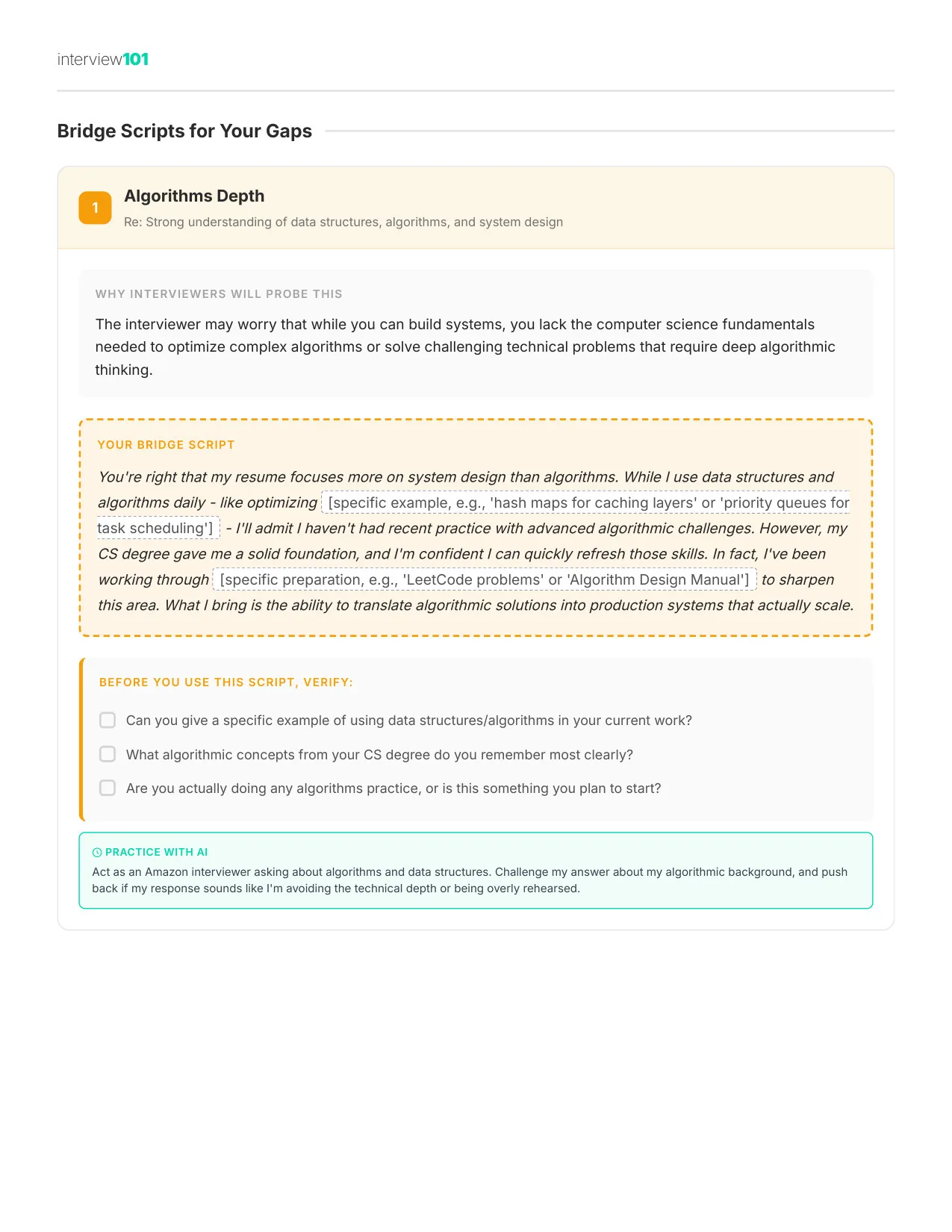
1
Algorithms Depth
Re: Strong understanding of data structures and algorithms
Your Bridge Script
"You're right that my resume focuses more on system design than algorithms. While I use data structures and algorithms daily — like [specific example] — I've been working through [prep approach] to sharpen this. What I bring is the ability to translate algorithmic solutions into production systems that actually scale."
Before You Use This Script, Verify:
Can you give a specific example of using algorithms in your current work?
Are you actually doing any practice, or is this something you plan to start?
Every gap your resume has gets a script. Not generic advice — the actual words, grounded in what you actually did, with a checklist to make sure it holds up under pressure.
10
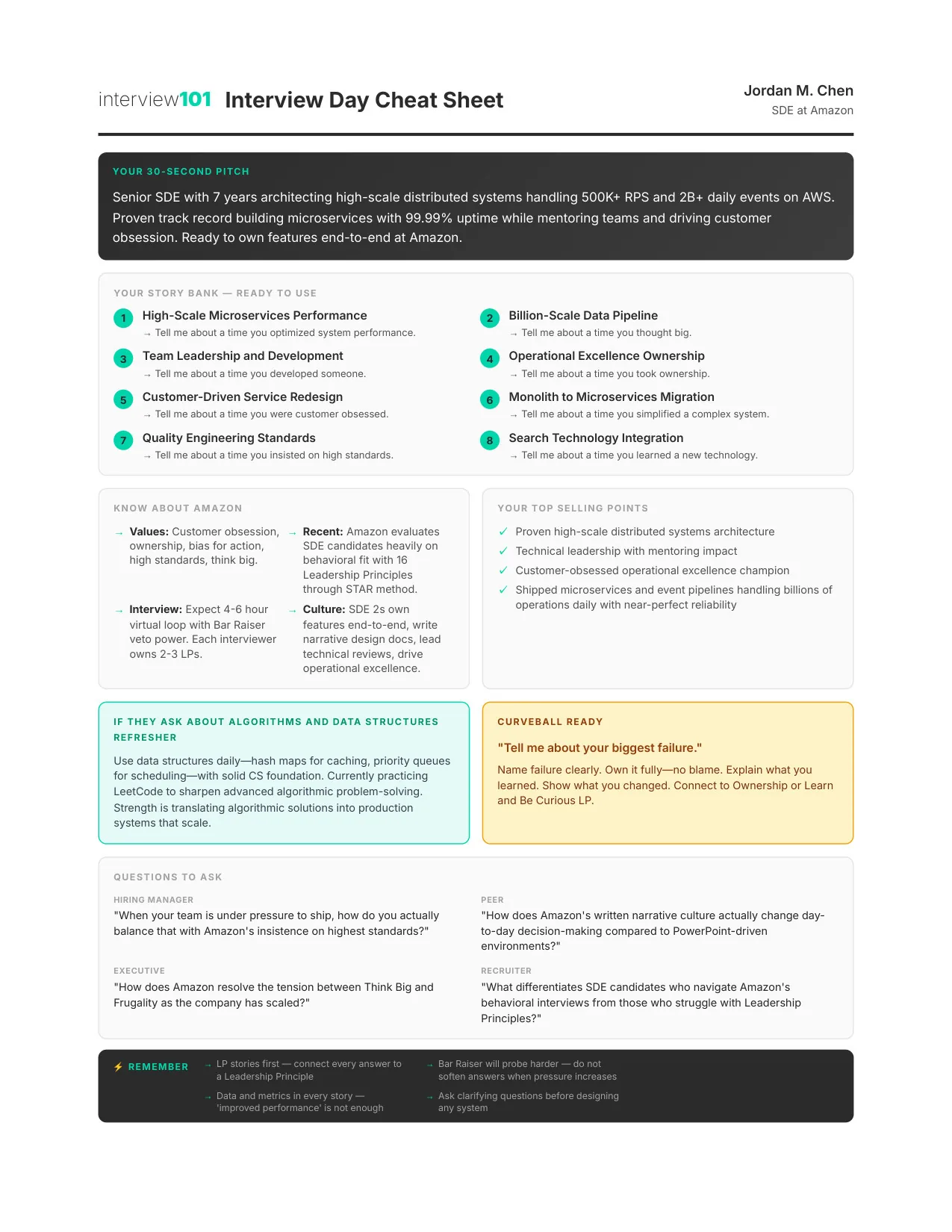
Section 10 — Interview Day Cheat Sheet
One page. Everything you need. Your name on it.
Jordan M. Chen
SDE · Amazon
No Interview101 branding
Your 30-Second Pitch
"Senior SDE with 7 years building distributed systems at Microsoft, Expedia, and Zillow. Architected microservices handling 500K+ RPS with 99.99% uptime..."
Story Bank
1
High-Scale Microservices → "optimize performance"
2
Billion-Scale Pipeline → "tell me about a time you thought big"
3
Team Leadership → "tell me about a time you developed someone"
Know About Amazon
4–6 hour virtual loop, Bar Raiser has veto power
Each interviewer owns 2–3 Leadership Principles
Written narrative culture — no PowerPoint
Curveball Ready
"Biggest failure" — name it, own it, show the lesson
Your 30-second pitch, story bank, company intelligence, and curveball frameworks — one page, your name on it. Print it. Bring it.

Every section is about your interview.

Not a template. Not a guide written for "someone applying to Amazon." A playbook written for you, applying for this specific role, at this specific company.

1
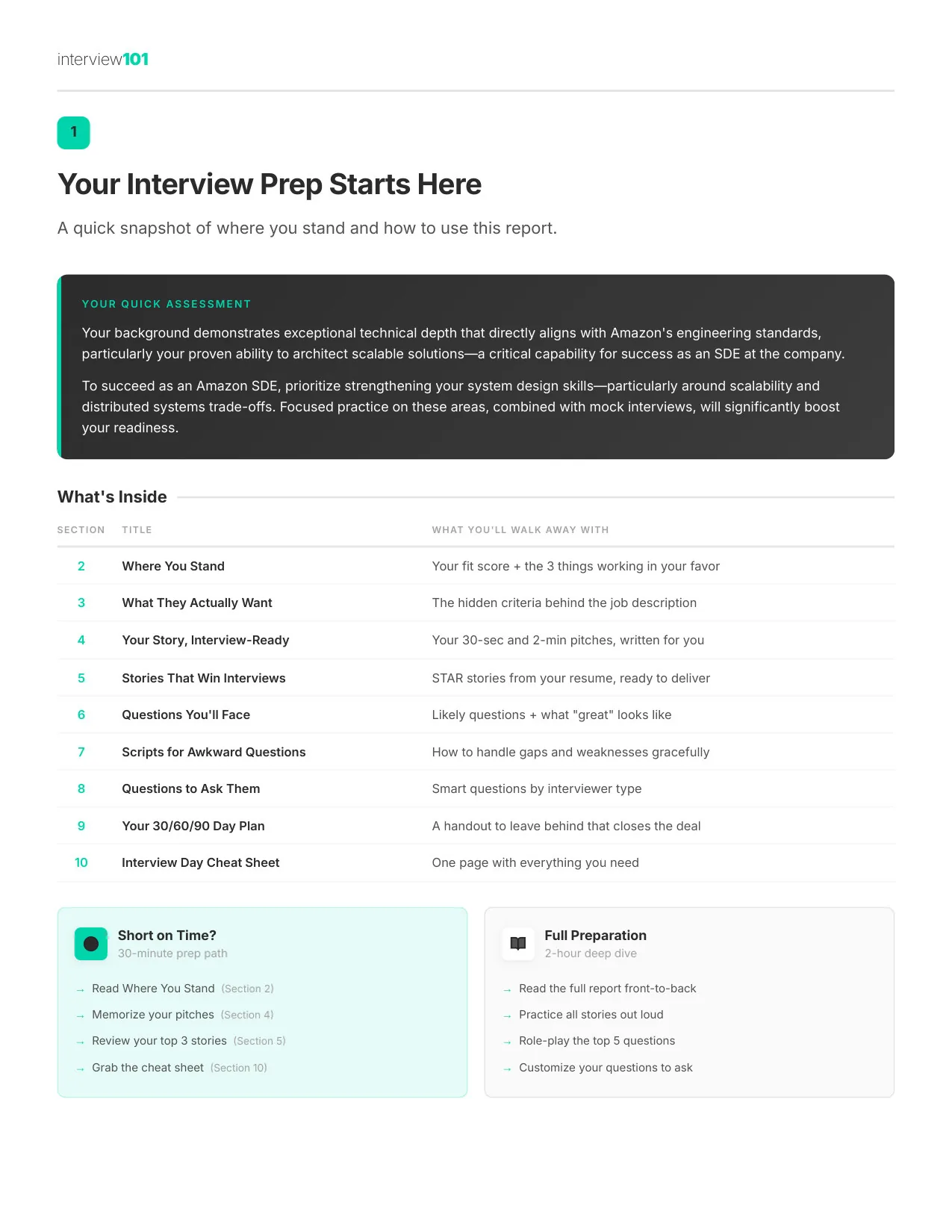
Where You Stand
A real fit score calculated from how closely your background matches the skills, experience level, and culture signals this company screens for. Your top strengths and top gaps, ranked by how much each one matters at this stage.
2
What They Actually Want
The job posting translated into what the team is really trying to solve — the explicit requirements, the implied ones, and the signals that tell you what's going wrong on the team right now.
3
Your Pitch
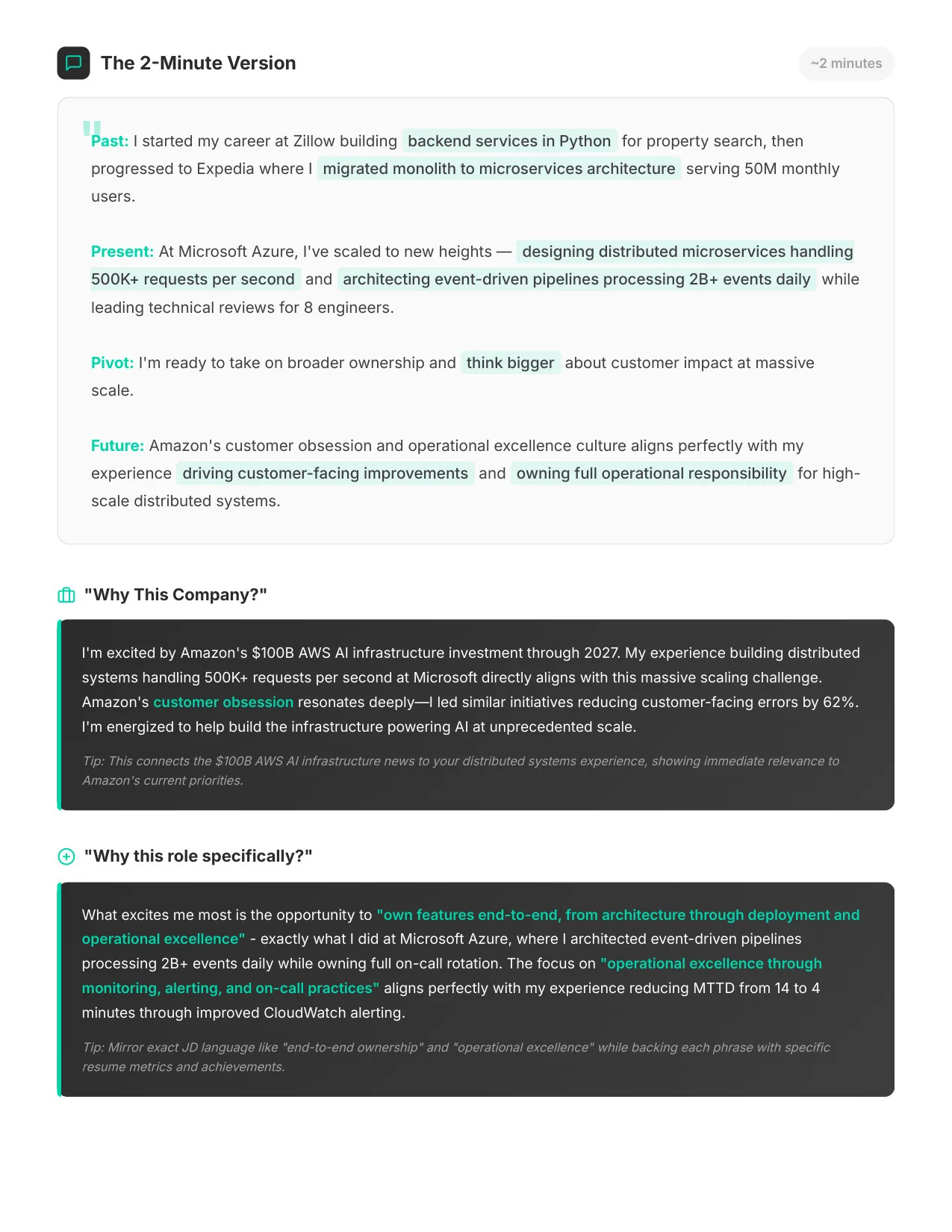
A 30-second intro and a 2-minute narrative built from your actual experience — crafted to land with this company's culture, not a generic "tell me about yourself" template.
4
Your Stories
Full STAR stories pulled from your resume, each mapped to the values and leadership principles this company weighs most heavily in behavioral rounds. Walk in with a ready answer for every question type they're likely to ask.
5
The Questions You'll Face
The questions most likely to come up — ranked by frequency across reported interviews for this company and role, each matched to which of your stories fits best.
6
Gap Scripts
For your top gaps: ready scripts that acknowledge the gap, pivot to what you do have, and close with evidence. The difference between fumbling a hard question and showing self-awareness under pressure.
7
Questions to Ask Them
Strategic questions tailored by who's across the table — hiring manager, peer, skip-level. Questions that show you've done the work and already think like someone in the role.
8
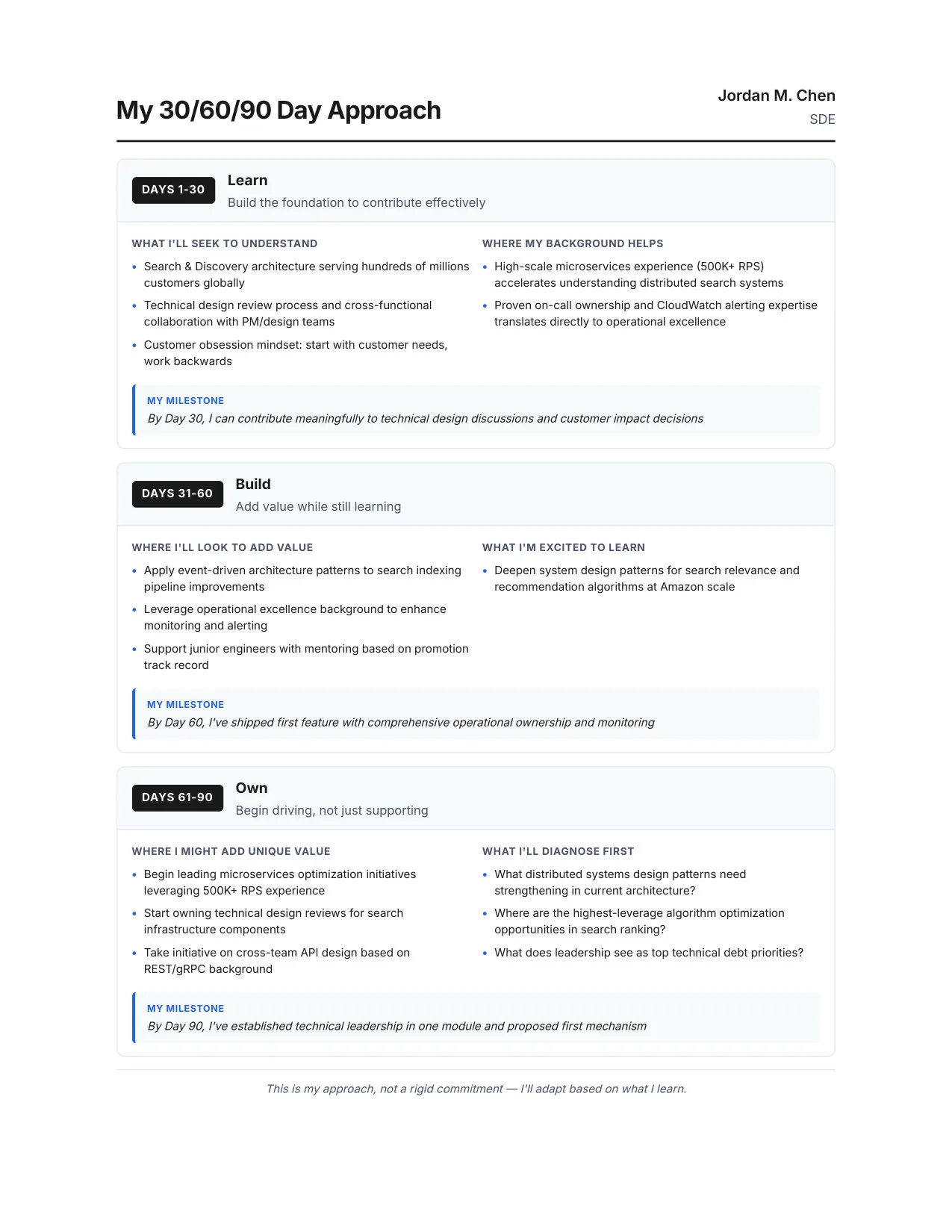
Your 30/60/90 Plan
A first-90-days roadmap built for this role. Shows the panel you're already thinking past the offer — one of the most consistent signals that separates a hire from a strong candidate who didn't get it.
9
Company Intelligence
What's happening at this company right now — strategic priorities, recent shifts, and what those mean for how they're evaluating candidates today. Updated quarterly.
10
Interview Day Cheat Sheet
One page. Your key stories, the themes to hit, things to avoid, and the questions you're asking. Review it once on the morning of, put it down, and walk in focused.
Every claim in your playbook traces directly to your resume or the job posting. Nothing is invented.

The 7 hardest interviews in tech.

Each company has its own interview system, its own evaluation criteria, its own definition of strong. Your playbook is built for the specific company you're interviewing at — not a generalized version of "big tech."

Built for your role, not just the company.

The bar for a Software Engineer at Google is fundamentally different from the bar for a Product Manager. Different question types, different evaluation criteria, different definitions of strong. Your playbook reflects that.

One playbook.
Everything you need.

You're applying for a role that could change your career. The cost of walking in underprepared is not $149.

Built from your actual resume
Every story, every strength, every gap identified comes from what you've actually done — not a generic template filled with placeholders.
Grounded in how this company actually interviews
The interview patterns, evaluation criteria, and what the hiring bar looks like at this specific company — sourced from reported interviews and updated quarterly.
Created by someone who sat in that chair
The rubric in your playbook reflects how interviewers actually evaluate candidates — built from the evaluator's side of the table, not from candidate guesswork.
Reviewed before it reaches you
Every playbook is checked by a human before delivery. Not automated and sent raw — reviewed to make sure it delivers before it lands in your inbox.
Interview Playbook
Your complete interview prep package
$ 149
One-time payment. One playbook. Your interview.
50+ page personalized PDF playbook
Real fit score vs. the actual hiring bar
STAR stories built from your resume
Predicted questions with answer frameworks
Gap scripts for your weakest areas
30/60/90 plan + interview day cheat sheet
Reviewed by a human before delivery
Delivered within 24 hours via email
Get My Playbook →
30-day money-back guarantee. No questions asked.

Different tools. Different jobs to be done.

LeetCode sharpens your coding. Coaching sessions give you real-time feedback. Interview101 gives you a complete, personalized prep plan in 24 hours — before you need any of those things to matter.

Good for coding drills
LeetCode / Courses
Personalized to your resume
Same content for everyone
STAR stories built for you
You build your own stories
Company-specific questions
Generic question lists
Evaluator's rubric
Not available
Cost
~$12–$144/year subscription
Time to be ready
Weeks to months of study
Good for live feedback
1-on-1 Coaching
Personalized to your resume
During the session
STAR stories built for you
Verbally, in one session
Company-specific questions
Depends on coach expertise
Evaluator's rubric
If the coach has it
Cost
$150–$300 per hour
Time to be ready
Depends on availability
Good for quick practice
ChatGPT / AI Tools
Personalized to your resume
Questions only
STAR stories built for you
Not included
Company-specific questions
Generic AI generation
Evaluator's rubric
Not available — hallucinated
Cost
~$9–$30/month subscription
Time to be ready
Immediate but no plan
Complete prep plan
Interview101
Personalized to your resume
Every section, every word
STAR stories built for you
Full stories from your resume
Company-specific questions
From 2,699+ real interviews
Evaluator's rubric
From an ex-Bar Raiser
Cost
$149 one-time
Time to be ready
24 hours
What Interview101 has that others don't
Interview101
$149 · One-time · 24 hours
Personalized to your resume — every section
STAR stories built from your actual resume
Questions from 2,699+ real reported interviews
The evaluator's rubric — from an ex-Bar Raiser
Gap scripts for your specific weaknesses
Ready in 24 hours — not weeks
Get My Playbook — $149 →

Common questions.

What makes this different from a generic interview guide?+
Every section of your playbook is generated from your resume and the exact job posting you're applying for, cross-referenced against how this specific company evaluates candidates for this specific role. The stories come from your actual experience. The predicted questions come from thousands of reported interviews at this company. The gap scripts address your actual gaps. Nothing is generic — every word is about you and this interview.
Which companies and roles are supported?+
We cover Amazon, Google, Meta, Microsoft, Apple, Netflix, and NVIDIA — the 7 companies with the most rigorous and well-documented interview processes in the industry. Across 6 roles: Software Engineer, Product Manager, Data Scientist, Data Engineer, Machine Learning Engineer, and Technical Program Manager.
How is the fit score calculated?+
The fit score is calculated deterministically — not an AI guess. It measures how closely your skills match what this role requires, how your experience level aligns with the seniority they're hiring for, and how well your background reflects the culture signals this company screens for. Each dimension is scored separately and you can see exactly how in your playbook.
How current is the interview data?+
We only use interview reports from the past three months. Interview patterns at these companies shift — a process change 18 months ago shouldn't be shaping your prep today. We track changes to interview formats, evaluation criteria, and round structures as they're reported, and update quarterly.
When will I receive my playbook?+
Within 24 hours of your order. You'll receive a confirmation immediately after purchase. Every playbook is reviewed by a human before it's sent — so you're not getting raw automated output. In practice, most arrive well within 24 hours.
What's the refund policy?+
30-day money-back guarantee. If your playbook doesn't deliver clear value, contact us within 30 days for a full refund. No conditions, no hoops.
Can’t I just use ChatGPT for this?+
You can upload your resume and job description to ChatGPT — and you’ll get something. What you won’t get is an actual interview model for this company and role: how rounds are structured, what the evaluator is trained to score, which values are weighted most heavily, and what the debrief looks like. That model was built from 2,699+ reported interviews. It reflects what actually happens in these loops — not what ended up in an AI’s training data.

ChatGPT also can’t give you the evaluation rubric. It will generate plausible-sounding criteria — but hallucinated criteria is the most dangerous kind of prep. If you walk in believing Amazon evaluates on X when they actually weight Y, you’ve optimized for the wrong thing.

The honest version: a technically strong candidate could spend 3–4 days prompting and iterating with ChatGPT to get close. Or spend 30 minutes with a structured playbook grounded in real data — with a 30-day guarantee behind it.

Walk in knowing.
Not hoping.

Your playbook is built from your resume, the job posting, and how this company actually decides who to hire. Everything else is noise.
Get My Interview Playbook — $149
30-day money-back guarantee · Delivered within 24 hours · Reviewed before delivery